
Why Handmade Things Still Matter in a Machine World
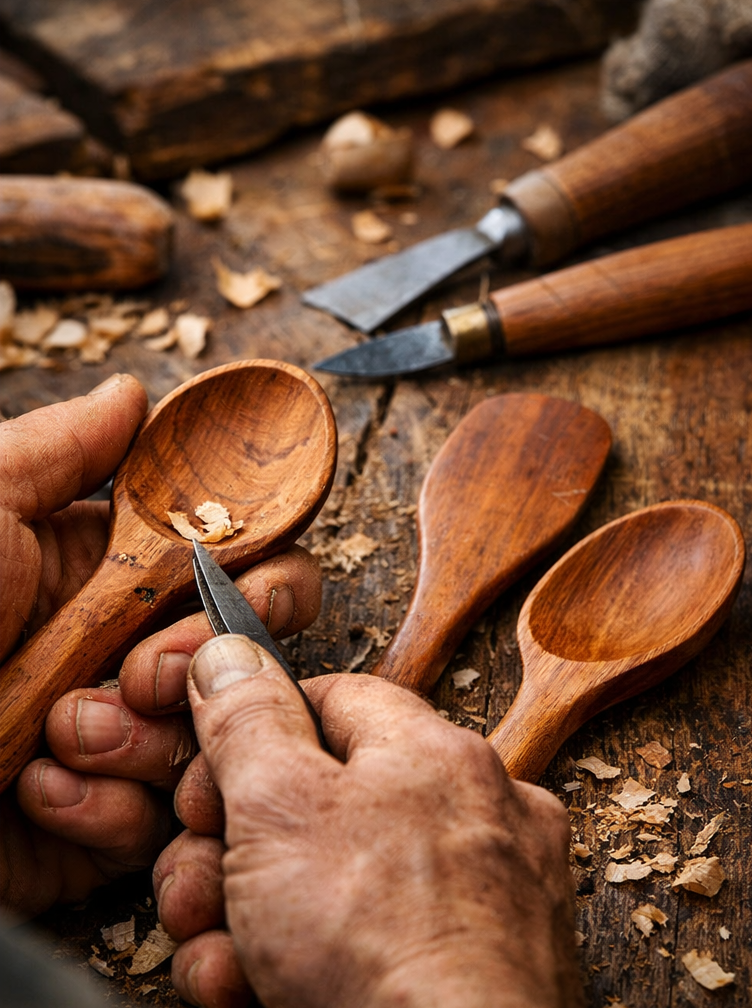
We live in a world that moves fast—faster than it probably should. Machines cut cleaner, produce more, and turn out identical pieces by the thousands without hesitation. There’s a certain brilliance in that efficiency, no doubt about it. But somewhere along the way, in all that speed and precision, something quieter has been pushed aside. And that’s where handmade work still holds its ground.
When you pick up something made by hand, you can feel it almost immediately. It’s not just the weight or the shape—it’s the subtle unevenness, the way the surface meets your fingers, the small decisions left behind in the grain. Those aren’t imperfections. They’re evidence. They tell you that someone stood there, tool in hand, paying attention. Not rushing. Not optimizing. Just working with the material in front of them, responding to it as it revealed itself.
That feeling is only deepened when the material itself carries a story. Some of the wood I work with isn’t just lumber—it’s history. I’ve had the opportunity to work with cherry that was cut in 1982 by Herry W. Smith, a miniature furniture maker out of Camden, Maine. He spent a lifetime shaping wood into something meaningful, and when he stepped away from that work, the wood he had gathered over the years found its way into new hands. When I pick up a piece from that stack, I’m not starting at the beginning. I’m continuing something.
There’s a kind of conversation that happens in that process. Wood is never just a raw input. Every board carries its own character—tight grain in one section, a softer run in another, subtle color shifts that only show themselves once the tool touches the surface. A machine doesn’t pause for that. It forces uniformity. But working by hand, you adjust. You follow the grain instead of fighting it. You let the material guide certain decisions. And in the case of that cherry, you’re not just reading the wood—you’re respecting the hands that selected it decades ago.
Time behaves differently in handmade work. Machines compress it. They take what once required hours and reduce it to moments. But when you’re shaping something by hand, time stretches back out. You slow down. You pay attention. You let the piece take the time it needs. And somehow, that time settles into the object itself. A utensil made from that 1982 cherry doesn’t just exist in the present—it carries years before it ever reached the bench, and hours of careful work after.
Over time, those pieces don’t just sit on a shelf—they live. A wooden spoon darkens where it’s handled most. Edges soften. The surface becomes smoother, not from sanding, but from use. It begins to reflect the life around it. That kind of wear isn’t damage; it’s memory. It’s the quiet record of meals cooked, hands that held it, days that passed. And when the material itself already carries decades behind it, that sense of continuity becomes even stronger.
Maybe that’s what this really comes down to. In a world built on efficiency, most things are made to be interchangeable. If one breaks, you replace it. If it wears out, you upgrade it. But handmade objects don’t fit into that system very well. They’re not identical. They’re not meant to be. They carry context—who made them, where they came from, and in some cases, who came before. That specificity gives them weight in a way that machines can’t replicate.
This isn’t about rejecting modern tools or progress. Machines have their place, and they’ve earned it. But handmade work offers something different. It brings back a sense of connection—to the material, to the process, and to the passage of time. It reminds us that not everything valuable is measured in speed or scale.
That’s why it still matters.
Because every once in a while, someone picks up a piece, feels that quiet difference, and recognizes it for what it is—not just an object, but a continuation of care, attention, and history held in their hands.